Flock cameras, ALPRs, and your route: what drivers should know
In 2020 a reader in Aurora, Colorado matched a stolen motorcycle’s plate to Brittney Gilliam’s SUV. Officers stopped the family at gunpoint and detained them, children included. The plate they were matching was from another state, on another kind of vehicle. Aurora later paid $1.9 million.
ALPRs can record vehicles that are not on a watchlist. Camera hardware, agency policies and database sharing determine what happens to those records. FlockDetour maps documented sites; its totals include several device classes and vendors, rather than a nationwide count of Flock Safety cameras or ALPRs. This page covers what plate readers record, how to recognize one on your street, and what you can do about the ones you cannot avoid.
What an ALPR is
An automated license plate reader (ALPR) is a camera paired with recognition software. It photographs every vehicle that passes, extracts the plate, and files the sighting into a searchable database with a timestamp and location. Many systems also record a vehicle profile: make, body type, color, roof racks, bumper stickers, and other distinguishing marks.
A single reader is unremarkable. Thousands of them, sharing one database, turn ordinary driving into a location history that can be queried later — which is why where the cameras sit matters.
What a Flock Safety camera records
Flock Safety is the largest ALPR vendor in the United States, selling to police departments, homeowner associations, and businesses. A typical capture from a fixed roadside camera includes:
- Plate number
- read and indexed
- Vehicle fingerprint
- make, body type, color, damage, stickers
- Location
- camera position and heading
- Timestamp
- to the second
- Direction of travel
- lane and bearing
- Retention
- set by vendor policy and state law
Beyond plate readers
Plate readers are the part of this you can see from the car, which is why they get the attention. They are one layer of a stack that has grown up around them, and the other layers are worth knowing by name:
- Real-time crime centersA control room that fuses everything below onto one map
An RTCC pulls live camera feeds, plate reads, gunshot alerts, drone video, 911 dispatch data and enrolled private cameras into a single screen an analyst watches in real time. EFF and the University of Nevada, Reno counted more than 80 across 29 states in 2020 and over 100 by 2022. This is the piece that changes the character of everything else: separately these are bounded tools, and fused they are a general-purpose way to follow someone.
Axon Fusus · FlockOS · Motorola CommandCentral Aware
- AI cameras and video analyticsCameras that classify what they see, not just record it
Video analytics can search recorded scenes for people or vehicles by visible attributes. Flock Safety’s separate video-camera product page advertises people-detection alerts. A video search and an ALPR search should not be treated as the same capability. Check the named product, enabled features and agency policy; the vendor name or shape of a camera does not establish whether facial recognition is used.
Verkada · Genetec · Axon · Flock Safety
- Drone as first responderDocked drones that launch to a call before an officer arrives
A weatherproof dock on a municipal roof releases a drone toward a 911 call, streaming video to dispatch. More than a thousand US agencies held FAA waivers for these flights by early 2026, and one California department has a waiver to fly city-wide at up to 400 feet. Chula Vista, which started in 2018, has passed 25,000 missions and publishes a public dashboard — the transparency here is genuinely better than most of this list.
Flock Aerodome · Axon and Skydio · Brinc
- Acoustic gunshot detectionPole-mounted microphones that flag loud impulsive sounds
Fifteen to twenty sensors per square mile listen for the acoustic signature of gunfire and route a clip to a human reviewer. The honest answer to “are they always listening” is that they monitor continuously and buffer locally, and when a loud enough event triggers, the audio clip travels with it — in a 2014 Oakland case that included a victim's voice. Chicago's Inspector General found in 2021 that alerts rarely produced evidence of a gun crime, and the city ended its contract in 2024. Flock piloted adding voice distress detection in 2025 and withdrew it in July 2026.
SoundThinking (ShotSpotter) · Flock Safety
The reason to group these rather than treat them separately is that a real-time crime center is designed to query them together. A plate read becomes a starting point for camera footage, which becomes a drone launch, which becomes a record that outlives the incident. EFF titled its survey of these rooms Surveillance Compounded, and the word is doing real work: the capability is not the sum of the parts.
How to spot one from the road
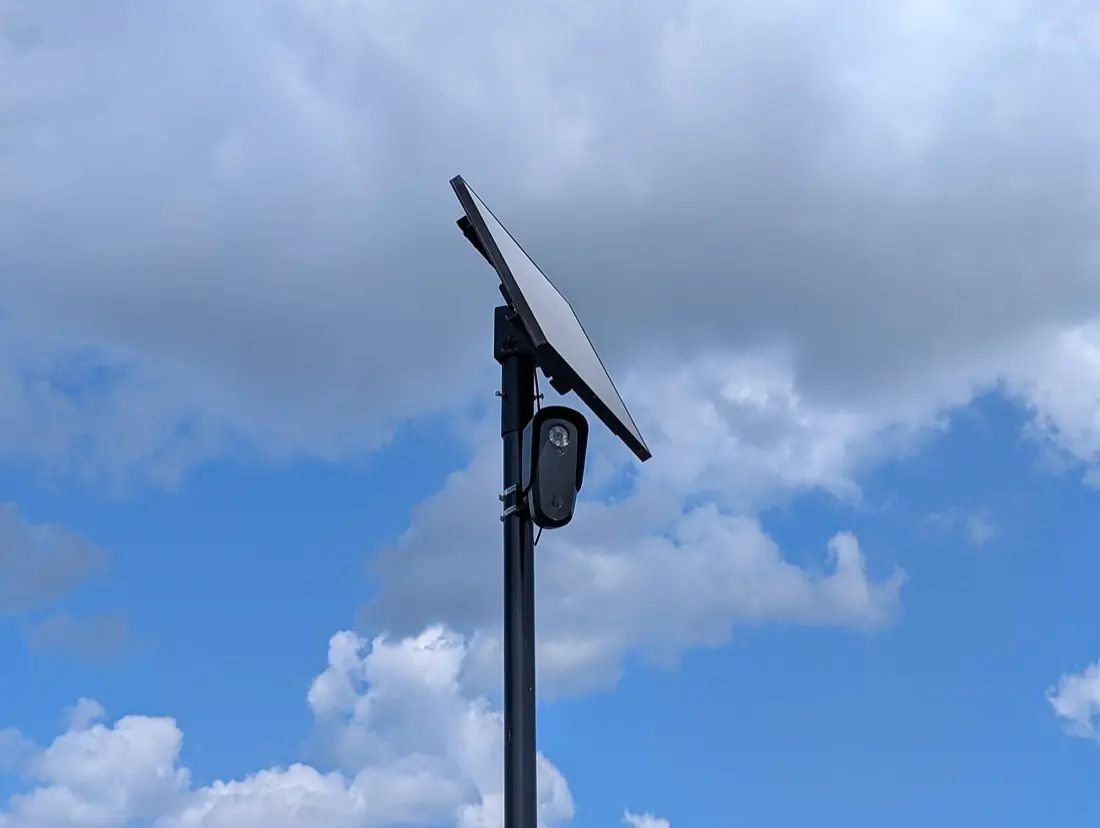
Fixed plate readers are not hidden, just unremarkable. Once you know the silhouette you will start seeing them on your own commute, usually in the same five configurations:
What it is probably not: a red-light or speed camera sits on the mast arm of an existing traffic signal, is physically larger, and has a cable running back to the signal cabinet. Traffic counters are small strapped boxes with no lens housing at all. And a fair warning — Flock Safety is the best-known vendor but not the only one. Motorola, Genetec, Leonardo, Neology and Axon all sell readers, and several ship units that look much like each other. Appearance is a strong hint. It is not an identification.
How long the data is kept, and who can search it
This is the question drivers ask first and almost nobody answers properly, because the honest answer is not a number. There is no federal retention standard. What governs your plate read is some combination of state law, the agency’s contract, and the vendor’s default — and those three frequently disagree.
- Virginia21 days
Statutory cap for fixed and portable readers, with sharing limits attached.
- New York1 year minimum
State model policy runs the other way — reads with investigative value are kept, not purged.
- North Carolina90 days
Statutory cap. A sworn preservation request extends it to a renewable year, and only then does the agency's own schedule govern.
- Most statesNo statute
Nothing in law sets a limit, so the vendor contract and the agency policy are the only rules.
- Flock Safety's default7 days
The vendor's LPR policy states a rolling 7-day default, adjustable when customer law or policy requires a different schedule. This is not a universal limit for every agency.
Accurate as of . Retention rules changed repeatedly through 2025 and 2026 — check your own state before relying on any figure here. Flock cut its default to 7 days in August 2026, and what agencies actually publish has its own guide.
Access is the other half. Searches are run by agency staff through named accounts and logged with a stated reason, and agencies can share their camera networks with each other. That sharing is what makes the reach hard to picture: a single search run by one Texas official in 2025 reached 6,809 networks and 83,345 cameras. Your local camera is rarely just a local camera.
Where the cameras are
Coverage varies wildly by state and even by neighborhood, which is what makes a documented map useful.
- active map records
- 203,101
- city directory
- US & Canada
- recorded sources
- 7
Latest recorded source ingestion: . These totals combine camera and related device classes and vendors. “Active” is a database status; it does not establish that every device is operating. Missing, duplicated or stale records mean these figures are not an installation census.
What the data has actually been used for
These documented cases show how plate-reader records have been used and what can happen when a match is wrong or data is shared beyond its original purpose. They do not establish how often those outcomes occur across agencies. Check each case’s source, date and jurisdiction before drawing a broader conclusion.
- Misread platesAurora, Colorado · 2020
A reader matched a stolen Montana motorcycle plate to Brittney Gilliam's SUV. Officers stopped the family at gunpoint and detained them, including children. Aurora settled for $1.9 million.
EFF, “The Human Toll of ALPR Errors”
- Misread platesSan Francisco · 2009
A reader misread a 3 as a 7. Denise Green was ordered out of her car at gunpoint, handcuffed, and made to kneel in the street. The city paid $495,000.
EFF, “The Human Toll of ALPR Errors”
- Stale recordsContra Costa County, California · 2019
Brian Hofer's car was flagged as stolen because the department had not updated its list after the vehicle was recovered. The plate read was correct; the database was not. Settled for $49,500.
EFF, “The Human Toll of ALPR Errors”
- Officer misuseKechi, Kansas · 2022
An officer was arrested on suspicion of using a Flock Safety database to track his estranged wife. It is not an isolated category — EFF documents comparable cases going back to a 1998 extortion conviction in Washington, D.C.
EFF, Street-Level Surveillance
- Immigration enforcementWashington State · 2025
The University of Washington Center for Human Rights obtained agency audit logs showing federal Border Patrol searches running across local camera networks between May and August 2025 — in several cases through departments that had never knowingly enabled federal sharing.
UWCHR, “Leaving the Door Wide Open”
- Reproductive careJohnson County, Texas · 2025
An official ran a plate search roughly two and a half hours after a report about a woman's self-managed abortion, logging the stated reason as “had an abortion, search for female”. The second search reached 6,809 networks and 83,345 cameras. Officials later described it as a welfare check; the detective's contemporaneous sworn affidavit described a death investigation and consulting the district attorney about charges.
EFF, October 2025
- Exposed systemsNationwide · 2025 and 2026
In January 2025 a researcher found Motorola ALPR units misconfigured to stream unencrypted video and plate data to the open internet; reporting put the count at 150 to 170 feeds. In January 2026 independent researchers found roughly 60 to 67 Flock PTZ cameras livestreaming with no login at all, exposing live video, a month of archive, and admin controls. Both vendors said they were addressing it.
404 Media, and researcher disclosures
- OversightWashington, DC · November 2025
Senator Ron Wyden and Representative Raja Krishnamoorthi asked the Federal Trade Commission to investigate Flock Safety, citing its failure to require multi-factor authentication and at least 35 customer accounts whose passwords had been stolen.
Office of Sen. Ron Wyden
- Who gets stoppedOak Park, Illinois · 2022-23
A local advocacy group reviewed a self-defined sample of 25 stops tied to camera alerts and found 84% involved Black drivers. The number worth comparing it against is not the village's roughly 19% Black population but the department's own 53% figure for all traffic stops in the 2022 state study — the disparity long predates the cameras. On a sample of about 21 people this is suggestive of an existing pattern being amplified, not proof of one being created.
Freedom to Thrive Oak Park; Illinois Traffic Stop Study
- State auditIllinois · August 2025
The Secretary of State audited twelve agencies and found plate data shared with Customs and Border Protection in violation of state law — including through a federal pilot the audit reported Flock Safety's own leadership was unaware of. Illinois ordered the access shut off.
Illinois Secretary of State, via NBC Chicago and NPR Illinois
Flock Safety has responded to much of this. Its published policy now sets a 7-day default retention, requires a stated reason on every search, and lets an agency switch federal sharing off. Whether those controls hold is a question the audits will answer, not the press releases — and the record above is largely the product of audits.
When the people with access misuse it
The cases above are failures of the machine. These are failures of the people holding the keys, and they are the more common kind. Every officer below was named in mainstream reporting, and the outcome stated is what actually happened to them — several were convicted, several resigned without ever being charged, and the difference is stated because it matters.
- Lt. Victor HeiarKechi Police Department, Kansas · 2022
Used a neighboring city's camera network to track his estranged wife's car over the course of a month, then told her she had been “spotted on Meridian.”
Pleaded guilty to computer crime and stalking. Eighteen months' probation, and Kansas revoked his law enforcement certification.
- Officer Josue AyalaMilwaukee Police Department, Wisconsin · 2026
Ran an ex-partner's plate more than 50 times and her new partner's more than 100 — 179 searches in about two months, each one logged with the reason “investigation.” It came to light because one of the people he was tracking looked her own plate up on a public audit-log tool.
Resigned, pleaded guilty to attempted misconduct in public office, sentenced to probation and a fine. Two four-year restraining orders granted against him.
- Officer Cristian MoralesMenasha Police Department, Wisconsin · 2025
Used department credentials off duty to search for an ex-girlfriend's vehicle. The victim described a history of physical abuse.
Convicted of misconduct in office after a judge rejected his plea deal. Six months in jail, three years' probation, and barred from law enforcement work.
- Officer Jarmarus BrownOrange City Police Department, Florida · 2024
Ran an ex-girlfriend's plate 69 times, her mother's 24 times and her father's 15 times over one summer. A colleague warned him to stop before anyone else noticed.
Arrested and charged.
- Two officers, both resignedApache Junction and Chandler, Arizona · 2026
One used the system to locate his wife, logged internally as a welfare check. The other used it to track a family member. Neither department completed its investigation before the officer left.
Both resigned and were referred to the state board that can strip a police certification. Neither has been charged. Chandler is not renewing its camera contract.
What connects them is not that the system was breached. It worked exactly as designed. A person with a legitimate login typed a plate, wrote a word in the reason box, and received a map of where someone had been. In the Milwaukee case that word was “investigation,” 179 times, and nothing stopped it — the person being tracked found out by looking her own plate up in released audit logs.
- 210.5 million
- plates read
- 5,911
- vehicles flagged
- 161
- innocent people stopped or investigated
Between August and September 2025 the Los Angeles Police Department's readers logged 210.5 million plate reads and flagged 5,911 vehicles. An Inspector General audit found 161 innocent people were stopped or investigated on stale or wrong hot-list data — some as high-risk stops, with backup and air support called in. One woman spent thirteen days in jail after being wrongly linked to a hit and run. A magazine editor was tracked for days and pulled over in Minnesota because of a data-entry error made in California. Los Angeles let its contract expire and suspended new deployments.
Do they work?
The whole arrangement is justified by whether these cameras work, and that has turned out to be harder to establish than anyone selling or opposing them tends to admit.
- What the vendor says
Flock Safety states that 10% of reported crime in the United States — more than 700,000 crimes a year — is solved using its technology. That figure comes from research written by Flock's own employees, extrapolated from a survey of 123 customer police departments. Of the two outside academics credited with overseeing it, one later told 404 Media he would have done the analysis differently, and that police data is too varied and incomplete for meaningful statistical analysis.
- What independent research has tested
A 2011 randomized experiment in the Journal of Experimental Criminology put license plate readers into 30 crime hot spots and found they did not generate either a general or an offense-specific deterrent effect. A later study in the same research line found a narrower result — some longer-lasting reduction in drug-offense calls. The literature is mixed and thin rather than settled.
- The gap nobody advertises
Every rigorous study we could find tests LPR-equipped patrol cars driven through hot spots — a different product from the always-on fixed grid your city buys. On that model we could find no independent peer-reviewed evaluation at all, in either direction. The only large study of it is the vendor's own.
- One city's numbers
A 2021 policy report analyzing 16 years of data from Piedmont, California found not even a moderate correlation between camera hits and stolen vehicle recoveries, and estimated that under 0.3% of hits produced a useful investigative lead. It is a single-city case study from advocacy-aligned organizations rather than peer review — one data point.
Our read: nobody has disproven fixed camera networks, and nobody without a commercial stake has tested them either. That is a more uncomfortable position than either the vendors or their critics tend to state, and it is a reasonable basis for wanting to choose your own exposure rather than wait for the evidence to settle.
What the law says
Two things drivers most often get backwards. Put plainly:
On the constitutional question, courts have so far mostly held that photographing a plate displayed in public is not a Fourth Amendment search, and a Virginia appellate court reversed a lower ruling on exactly that basis in 2025. The unsettled part is aggregation — whether months of one vehicle’s movements, assembled from thousands of cameras, is a different thing in law than a single photograph. Records law has moved faster: a Washington court held in November 2025 that Flock camera images are public records, and that a vendor hosting them on its own servers does not change that.
This is general background, not legal advice. State law varies a great deal and changes often — talk to a lawyer in your state about your own situation. The short version, with sources: is it legal to avoid Flock cameras?
What you can do about it
You cannot opt out of being photographed on a public road, but you can decide how many documented readers your daily driving passes:
What FlockDetour does — and honestly cannot do
FlockDetour routes you around cameras that are documented in its current dataset and warns you as you approach them. That is the whole promise, and it has a hard edge:
Questions drivers ask
Can I cover or obscure my license plate to avoid ALPR cameras?
Is it legal to drive a route that avoids license plate readers?
Do license plate readers work at night or in bad weather?
How accurate are license plate readers?
What is a hotlist?
How long do police keep my license plate data?
Can a private citizen look up license plate data?
How do I find out whether someone searched for my plate?
Does my HOA or apartment complex have license plate readers?
Do plate readers see out-of-state plates?
How do I get plate readers removed from my town?
Is FlockDetour affiliated with Flock Safety?
Sources & further reading
- Flock Safety — video cameras— vendor description of people-detection alerts and video analytics; checked October 3, 2026
- Tommy G — Investigating Flock: America's Mass Surveillance Company— the 42-minute documentary embedded at the top of this page, on video
- EFF — Street-Level Surveillance: ALPRs— the standard technical and legal reference for how these systems work
- EFF — The Human Toll of ALPR Errors— the documented wrongful-stop cases, with settlements
- EFF — the Texas search that was called a welfare check— official account against the sworn affidavit
- UWCHR — Leaving the Door Wide Open— agency-by-agency audit of federal access to Washington camera networks
- EFF — Washington court rules Flock data is a public record— vendor hosting does not put the images beyond records law
- ACLU — You Are Being Tracked— the original nationwide records project on plate readers
- ACLU — Get the Flock Out— their campaign, its figures, and a local advocacy toolkit
- Flock Safety — LPR policy— the vendor's own retention and access rules, in their words
- Flock Safety — privacy policy— the second document, still describing the older 30-day rule
- The Intercept — HOAs, plate readers, and the police— how private neighborhood cameras reach law enforcement
- Lum et al. — LPR patrols in crime hot spots— the randomized experiment, Journal of Experimental Criminology, 2011
- 404 Media — the researcher who oversaw Flock's study— his own reservations about how it was done
- Independent Institute — a study in failure— the Piedmont analysis; advocacy-published, not peer-reviewed
- Sen. Wyden and Rep. Krishnamoorthi — letter to the FTC— the multi-factor authentication findings, November 2025
- EFF — Surveillance Compounded— the survey of real-time crime centers the stack section draws on
- 404 Media — LAPD stopped innocent people on bad hot-list data— the Inspector General audit, 161 wrongful stops in two months
- 404 Media — officers keep getting arrested for using Flock to stalk— the running record of named cases and their outcomes
- 404 Media — ICE taps into the nationwide camera network— thousands of searches logged with immigration reasons
- EFF — Atlas of Surveillance— crowdsourced record of which agencies run which technology
- Have I Been Flocked?— search released audit logs for your own plate
- EFF — how Austin's organizers canceled the city's contract— the audit findings and the campaign that used them
- 404 Media — continuing Flock Safety coverage— the reporting most of the 2025-26 record rests on
- New York DMV — plate cover penalties— why obscuring a plate is never the workaround
- New York State model ALPR policy— a retention rule that runs opposite to the usual assumption
- OpenStreetMap surveillance tagging— the open dataset the camera layer builds on
- DeFlock— an independent community map documenting the same hardware